Generation 1
Helix Fossil
Omanyte → Omastar
Evolves at level 40
Prehistoric Pokémon revived from ancient fossils
Explore every Fossil Pokémon from Omanyte and Kabuto to Dracovish and Arctovish. See which fossil revives into each Pokémon, compare evolution families and base stats, and learn how the unusual Galar fossil combinations work.



There are 25 Fossil Pokémon species across 15 revival families or results. Fossil Pokémon were introduced in Generations I, III, IV, V, VI and VIII. Generations II, VII and IX did not introduce new Fossil Pokémon.
The species total includes Pokémon revived directly from fossils and their later evolutions. The family total counts each independent revival family or Generation VIII revival result, not 25 different fossil items.
Fossil Pokémon are species connected to fossil items or preserved remains that can be restored in main-series Pokémon games.
In many games, a fossil can be taken to a scientist, museum, or laboratory and revived into a living Pokémon. The directly revived Pokémon and their later evolutions are generally grouped together as Fossil Pokémon.
Most traditional Fossil Pokémon have Rock as one of their types. Generation VIII is different: Pokémon Sword and Shield combine an upper fossil piece with a lower fossil piece to produce one of four results.
A prehistoric appearance alone does not make a species a Fossil Pokémon. The category depends on a documented connection to revival from fossil items.
Match every fossil item or Galar fossil pair with the Pokémon it restores and any later evolution.
| Generation | Fossil | Revived Pokémon | Evolution | Type | Evolution Requirement |
|---|---|---|---|---|---|
| Generation 1 | Helix Fossil | Omanyte | Omanyte → Omastar | Evolves at level 40 | |
| Generation 1 | Dome Fossil | Kabuto | Kabuto → Kabutops | Evolves at level 40 | |
| Generation 1 | Old Amber | Aerodactyl | Does not evolve | Does not evolve | |
| Generation 3 | Root Fossil | Lileep | Lileep → Cradily | Evolves at level 40 | |
| Generation 3 | Claw Fossil | Anorith | Anorith → Armaldo | Evolves at level 40 | |
| Generation 4 | Skull Fossil | Cranidos | Cranidos → Rampardos | Evolves at level 30 | |
| Generation 4 | Armor Fossil | Shieldon | Shieldon → Bastiodon | Evolves at level 30 | |
| Generation 5 | Cover Fossil | Tirtouga | Tirtouga → Carracosta | Evolves at level 37 | |
| Generation 5 | Plume Fossil | Archen | Archen → Archeops | Evolves at level 37 | |
| Generation 6 | Jaw Fossil | Tyrunt | Tyrunt → Tyrantrum | Evolves at level 39 or higher during the daytime | |
| Generation 6 | Sail Fossil | Amaura | Amaura → Aurorus | Evolves at level 39 or higher during the nighttime | |
| Generation 8 | Fossilized Bird + Fossilized Drake | Dracozolt | Does not evolve | Does not evolve | |
| Generation 8 | Fossilized Bird + Fossilized Dino | Arctozolt | Does not evolve | Does not evolve | |
| Generation 8 | Fossilized Fish + Fossilized Drake | Dracovish | Does not evolve | Does not evolve | |
| Generation 8 | Fossilized Fish + Fossilized Dino | Arctovish | Does not evolve | Does not evolve |
Generation 1
Omanyte → Omastar
Evolves at level 40
Generation 1
Kabuto → Kabutops
Evolves at level 40
Generation 1
Aerodactyl
Does not evolve
Generation 3
Lileep → Cradily
Evolves at level 40
Generation 3
Anorith → Armaldo
Evolves at level 40
Generation 4
Cranidos → Rampardos
Evolves at level 30
Generation 4
Shieldon → Bastiodon
Evolves at level 30
Generation 5
Tirtouga → Carracosta
Evolves at level 37
Generation 5
Archen → Archeops
Evolves at level 37
Generation 6
Tyrunt → Tyrantrum
Evolves at level 39 or higher during the daytime
Generation 6
Amaura → Aurorus
Evolves at level 39 or higher during the nighttime
Generation 8
Dracozolt
Does not evolve
Generation 8
Arctozolt
Does not evolve
Generation 8
Dracovish
Does not evolve
Generation 8
Arctovish
Does not evolve
Unlike traditional fossils, the Galar fossils are incomplete pieces. One upper fossil is combined with one lower fossil to create one of four Pokémon.
All four Galar Fossil Pokémon are standalone revival results and do not evolve.
Compare all six base stats and total base stats for the 25 standard Fossil Pokémon species. Mega Aerodactyl is excluded from this comparison.
| Type | |||||||||
|---|---|---|---|---|---|---|---|---|---|
| Archeops#567 | Generation 5 | RockFlying | 75 | 140 | 65 | 112 | 65 | 110 | 567 (Highest value) |
| Tyrantrum#697 | Generation 6 | RockDragon | 82 | 121 | 119 | 69 | 59 | 71 | 521 |
| Aurorus#699 | Generation 6 | RockIce | 123 (Highest value) | 77 | 72 | 99 | 92 | 58 | 521 |
| Aerodactyl#142 | Generation 1 | RockFlying | 80 | 105 | 65 | 60 | 75 | 130 (Highest value) | 515 |
| Dracozolt#880 | Generation 8 | ElectricDragon | 90 | 100 | 90 | 80 | 70 | 75 | 505 |
| Arctozolt#881 | Generation 8 | ElectricIce | 90 | 100 | 90 | 90 | 80 | 55 | 505 |
| Dracovish#882 | Generation 8 | WaterDragon | 90 | 90 | 100 | 70 | 80 | 75 | 505 |
| Arctovish#883 | Generation 8 | WaterIce | 90 | 90 | 100 | 80 | 90 | 55 | 505 |
| Omastar#139 | Generation 1 | RockWater | 70 | 60 | 125 | 115 (Highest value) | 70 | 55 | 495 |
| Kabutops#141 | Generation 1 | RockWater | 60 | 115 | 105 | 65 | 70 | 80 | 495 |
| Cradily#346 | Generation 3 | RockGrass | 86 | 81 | 97 | 81 | 107 | 43 | 495 |
| Armaldo#348 | Generation 3 | RockBug | 75 | 125 | 100 | 70 | 80 | 45 | 495 |
| Rampardos#409 | Generation 4 | Rock | 97 | 165 (Highest value) | 60 | 65 | 50 | 58 | 495 |
| Bastiodon#411 | Generation 4 | RockSteel | 60 | 52 | 168 (Highest value) | 47 | 138 (Highest value) | 30 | 495 |
| Carracosta#565 | Generation 5 | WaterRock | 74 | 108 | 133 | 83 | 65 | 32 | 495 |
| Archen#566 | Generation 5 | RockFlying | 55 | 112 | 45 | 74 | 45 | 70 | 401 |
| Tyrunt#696 | Generation 6 | RockDragon | 58 | 89 | 77 | 45 | 45 | 48 | 362 |
| Amaura#698 | Generation 6 | RockIce | 77 | 59 | 50 | 67 | 63 | 46 | 362 |
| Omanyte#138 | Generation 1 | RockWater | 35 | 40 | 100 | 90 | 55 | 35 | 355 |
| Kabuto#140 | Generation 1 | RockWater | 30 | 80 | 90 | 55 | 45 | 55 | 355 |
| Lileep#345 | Generation 3 | RockGrass | 66 | 41 | 77 | 61 | 87 | 23 | 355 |
| Anorith#347 | Generation 3 | RockBug | 45 | 95 | 50 | 40 | 50 | 75 | 355 |
| Tirtouga#564 | Generation 5 | WaterRock | 54 | 78 | 103 | 53 | 45 | 22 | 355 |
| Cranidos#408 | Generation 4 | Rock | 67 | 125 | 40 | 30 | 30 | 58 | 350 |
| Shieldon#410 | Generation 4 | RockSteel | 30 | 42 | 118 | 42 | 88 | 30 | 350 |
Browse all 25 Fossil Pokémon, including the Pokémon revived directly from fossils and their evolved forms.
25 of 25 Pokémon shown
BST 355
BST 495
BST 355
BST 495
BST 515
BST 355
BST 495
BST 355
BST 495
BST 350
BST 495
BST 350
BST 495
BST 355

BST 495
BST 401
BST 567
BST 362
BST 521
BST 362
BST 521
BST 505
BST 505
BST 505
BST 505
See when each fossil revival family or result entered the National Pokédex, including generations that introduced no new Fossil Pokémon.
Generation I established the classic pattern of choosing a fossil and restoring its Pokémon in a laboratory.


Generation II introduced no new Fossil Pokémon.
No new Fossil Pokémon introduced
Generation III added the Root Fossil and Claw Fossil families.


Generation IV introduced Cranidos and Shieldon through the Skull Fossil and Armor Fossil.


Generation V added the aquatic Tirtouga family and the feathered Archen family.


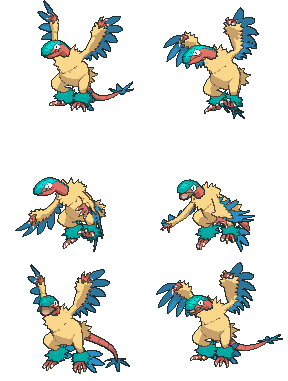
Generation VI introduced Tyrunt and Amaura, whose evolutions have daytime and nighttime requirements.


Generation VII introduced no new Fossil Pokémon.
No new Fossil Pokémon introduced
Generation VIII combined four fossil components into four standalone Pokémon instead of using one complete fossil for one family.


Generation IX introduced no new traditional Fossil Pokémon. Ancient Paradox Pokémon remain a separate category.
No new Fossil Pokémon introduced
The exact location changes by game, but fossil revival usually follows the same three-step process.
Fossils may be chosen, discovered, received, or obtained through mechanics that vary by game.
A scientist, museum, or laboratory restores the fossil. The responsible character and location differ between games.
The restored Pokémon joins the player’s collection and can evolve normally when that family has a later stage.
Ancient origins or a prehistoric design do not automatically place a species in the Fossil Pokémon group.
Relicanth looks ancient, but it is not revived from a fossil and is not part of the Fossil Pokémon group.
RelicanthGenesect’s lore involves an ancient Pokémon modified by Team Plasma, but Genesect is a Mythical Pokémon rather than a Fossil Pokémon.
Pokémon such as Great Tusk and Roaring Moon have prehistoric themes, but Paradox Pokémon are a separate category.
Explore Paradox PokémonLooking like a dinosaur or extinct animal is not enough. This category is based on a documented fossil revival connection.
Continue exploring Pokémon groups, forms, transformations, and special collections across the National Pokédex.
Explore region-defining guardians, box mascots, legendary trios, and other rare Pokémon.
ExploreDiscover rare Pokémon traditionally connected to events, special distributions, and unique quests.
ExploreCompare the powerful three-stage families commonly known as pseudo-legendaries.
ExploreCompare Alolan, Galarian, Hisuian, and Paldean forms with their original species.
ExploreCompare the ancient and futuristic Pokémon discovered in Area Zero.
ExploreMeet the extradimensional Pokémon that arrived through Ultra Wormholes in Alola.
ExploreBrowse every Mega-Evolved Pokémon, including typings, Abilities, and stat changes.
ExploreExplore Pokémon with unique Gigantamax appearances and signature G-Max Moves.
ExploreCompare Eevee’s evolutions, evolution methods, types, Abilities, and roles.
ExploreCheck which Pokémon, forms, games, and encounters prevent a legitimate Shiny result.
ExploreExplore all 19 Baby Pokémon, their evolution methods, breeding history, and complete evolution families.
ExploreSearch Pokémon, moves, abilities, types, items, and locations.