
Legendary Pokémon by Generation
From Gen I to Gen IX. Each entry includes an internal Pokédex link, typings, and a one-line “how it plays / why it matters” read.
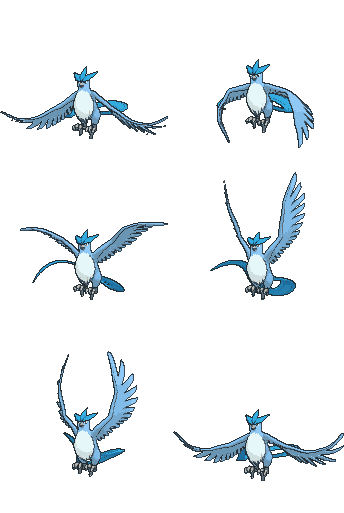 ArticunoDefensive, patient play—great into bulky targets, but hates Rock pressure.
 ZapdosFast and consistent—checks common Water/Flying cores and rarely feels useless.
 MoltresExplosive damage with real volatility—Stealth Rock matchups define its comfort.
 MewtwoThe original “boss legend”: absurd stats and coverage, but must respect Dark/Ghost revenge plans.
 RaikouSpeedy special pressure—clean, simple, and excellent at forcing switches.
 EnteiStraight-line offense—hits hard, but often needs support to break bulky Waters.
 SuicuneClassic bulk wincon—if it gets time, it snowballs; if it doesn’t, it feels slow.
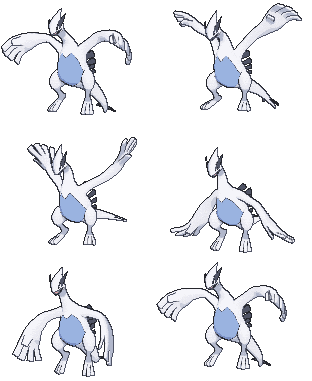 LugiaA defensive titan—wins by refusing to die, not by racing damage.
 Ho-OhNuclear hits with big weaknesses—matchup-heavy, terrifying when it’s in the right game.
 RegirockPure bulk and chip—excellent into physical attackers, but can be passive.
 RegiceSpecial sponge with a brutal defensive typing—strong on paper, awkward in many metas.
 RegisteelThe definition of “glue”: resists everything, wins with patience and smart utility.
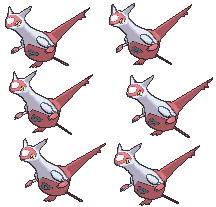 LatiasFlexible support or calm setup—great role compression when you need speed + bulk.
 LatiosMore punch than Latias—threatens immediate progress, but trades durability.
 KyogreWeather-fueled special nuke—few Pokémon switch in safely when it’s online.
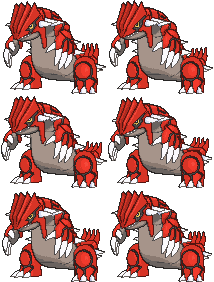 GroudonPremium physical legend—sets tempo with sun synergy and monstrous Ground pressure.
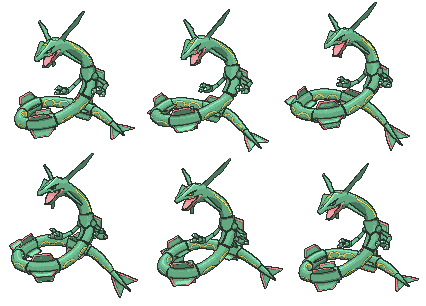 RayquazaRaw damage first, questions later—legendary for a reason, but needs respect for speed control.
 UxiePure utility—sets screens and momentum, rarely the damage source.
 MespritJack-of-all—can pivot, hit, or support, but rarely the best at one thing.
 AzelfTempo legend—fast hazards or fast hits; wins by acting first.
 DialgaElite resist profile and huge damage—hard to trade with cleanly.
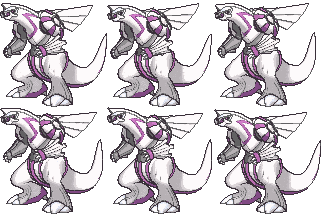 PalkiaOffensive coverage monster—punishes common cores with STABs that don’t overlap.
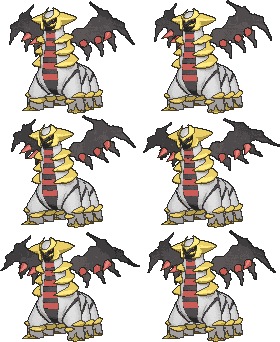 GiratinaA wall with bite—checks a lot, but must respect Ice/Fairy pressure.
 HeatranMeta staple typing—punishes Fairies/Steels, but hates Ground and chip.
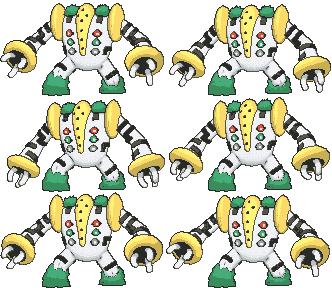 RegigigasMassive stats, infamous drawback—fun in casual, tricky in serious play.
 CresseliaDefensive “moon wall”—wins by outlasting and enabling teammates.
 CobalionFast utility Steel—great resist profile, more team glue than closer.
 TerrakionHigh immediate threat—if it finds one opening, something usually drops.
 VirizionNiche but useful—checks some Waters and Grounds, but relies on matchups.
 TornadusSpeed + utility—annoys teams with tempo and disruptive options.
 ThundurusOffensive prankster energy—forces respect with both damage and utility.
 LandorusThe “default good Pokémon”—Ground pressure + immunity profile fits everywhere.
 ReshiramSpecial wallbreaker—few defensive answers handle both STABs comfortably.
 ZekromPhysical pressure with great coverage—punishes passive lines hard.
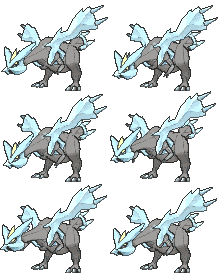 KyuremIce/Dragon is scary offensively—defensively fragile, but it creates real damage races.
 Tapu KokoFast terrain pressure—forces awkward defensive turns immediately.
 Tapu LelePsychic Terrain nukes—teams must plan around its burst windows.
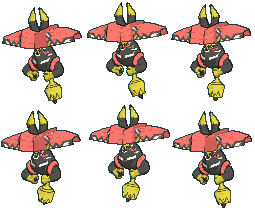 Tapu BuluPhysical power with terrain sustain—great in short trades, matchup-sensitive.
 Tapu FiniDefensive utility queen—denies status and stabilizes messy games.
 SolgaleoBulky Steel legend—strong into Fairies, wants careful Ground/Dark management.
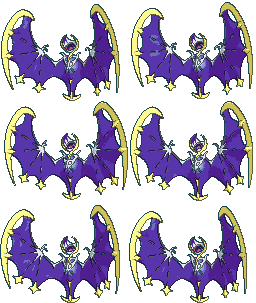 LunalaExplosive special threat—can feel unfair if it gets one free turn.
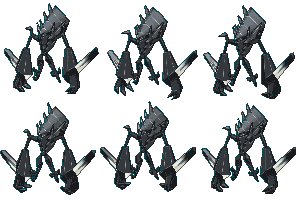 NecrozmaForm-dependent menace—base is modest, but the line’s ceiling is infamous.
 NihilegoUltra Beast glass cannon—great offensively, fragile defensively.
 BuzzwolePhysical stat monster—wins if it finds the right targets.
 PheromosaSpeed-first offender—either snowballs or gets checked; very polar.
 XurkitreeSpecial sweeper profile—if it starts boosting, it spirals quickly.
 CelesteelaAnnoyingly durable—wins by outlasting and punishing impatience.
 KartanaRidiculous physical offense—teams must respect its damage benchmarks.
 GuzzlordHuge HP, awkward defense—dangerous if you underestimate its trades.
 PoipolePre-evo Ultra Beast—mostly a stepping stone to real power.
 NaganadelSpeedy special sweeper—snowballs hard with boosts and coverage.
 StakatakaExtreme min-max bulk—either walls you or gets exploited by key weaknesses.
 BlacephalonGlass cannon nuker—wins by forcing trades on its terms.
 ZacianOne of the most feared statlines—wins games by simply being faster and stronger.
 ZamazentaDefensive focus—can be excellent glue, but needs the right meta to shine.
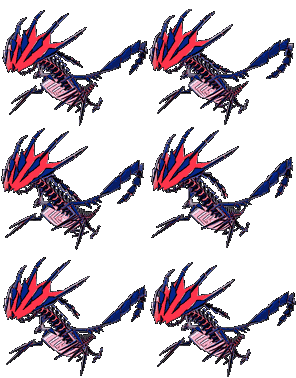 EternatusSpecial pressure with staying power—hard to check without dedicated answers.
 KubfuA story legend-in-training—its value is what it becomes.
 UrshifuMeta-defining in many formats—breaks defensive habits with brutal consistency.
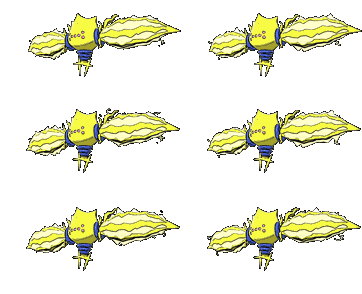 RegielekiPure speed + pressure—either dominates tempo or gets stonewalled by Grounds.
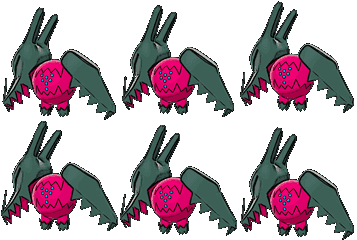 RegidragoSimple but explosive—wins when its Dragon damage is hard to answer.
 GlastrierSlow tank—terrifying in Trick Room style games, otherwise needs help.
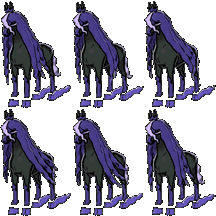 SpectrierFast special sweeper—snowballs quickly if you let it get rolling.
 CalyrexForm-driven legend line—base is mild, but the ecosystem around it is huge.
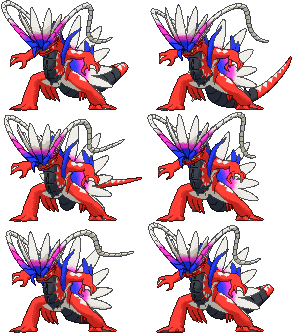 KoraidonAggressive physical presence—if it gets momentum, it forces damage trades.
 MiraidonSpecial pressure with speed—punishes slow teams brutally.
 Wo-ChienDefensive ruin—wins by draining resources and dragging games long.
 Chien-PaoSpeed + lethal damage—one of the scariest ‘hit first’ ruin picks.
 Ting-LuBulk anchor—stabilizes teams and makes special attackers work for it.
 Chi-YuSpecial nuke—melts teams that rely on soft special checks.
 OgerponDLC story legend—fast, flexible, and all about clean game plans.
 OkidogiBrawler archetype—wins when it can stay in and trade up.
 MunkidoriTrickster pressure—utility plus damage, but needs careful piloting.
 FezandipitiSupportive legend—matchup tools matter more than raw stats.
 TerapagosEndgame boss vibe—plays around form/defense; strong when built around.
Types of Legendary Pokémon
Community shorthand matters. These buckets aren’t official classifications, but they are how players talk about legendaries in teams and in discussion.
Box Legendaries
The main mascots on a game’s cover—usually high BST and story central.
Mythical Pokémon
Often event/quest distributed and intentionally elusive—distinct from legendaries even if the stats are similar.
- See the dedicated list: Mythical Pokémon
Legendary Trios
Sets of three that share a theme (beasts, birds, lake trio, swords, etc.). They’re often the ‘sub-legends’ of a region.
Ultra Beasts
Alola’s extradimensional ‘UB’ roster is a separate classification from Legendary Pokémon, despite similarly limited and story-focused encounters.
- Examples: Kartana, Celesteela, Nihilego
- See the dedicated list: Ultra Beasts
Strongest Legendary Pokémon
A practical top 10 (cross-format) based on raw stats, impact, and competitive history—not a tier list for any one ruleset.
How to Get Legendary Pokémon
The exact method depends on the game, but most legendaries fall into a handful of patterns. Think “scripted encounter,” not “random route.”
Story / Post-game encounters
Many legendaries are guaranteed encounters tied to the main plot or the post-game.
- Often one per save: bring status moves, Ultra Balls, and don’t KO it by accident.
- Sometimes you get a re-match window; sometimes you don’t—save before you engage.
Roaming legendaries
A few games use roamers that move between routes and can flee quickly.
- Use trapping tools and chip damage; plan for repeated short encounters.
- Expect time investment—this is the opposite of a clean scripted capture.
Raids, special battles, and DLC quests
Modern games frequently place legendaries behind raid-like content, limited-time events, or DLC storylines.
- Check difficulty scaling—some are balanced around co-op or late-game teams.
- Availability changes over time; if you missed it, trading is often the practical solution.
Version exclusives, trading, and transfers
Some legendaries are locked behind version choice, trading, or cross-game transfers.
- If a legendary is version-exclusive, trading is the intended “complete the set” path.
- Transfers/imports vary by generation—always verify what your current title supports.
Per-legend availability notes
These are the most common acquisition patterns across main-series titles. Always double-check your specific game’s version, DLC, and event rules.
Classic acquisition: a fixed battle in the Seafoam Islands in Red/Blue/Yellow and FireRed/LeafGreen.
- A true static legendary: not random grass, usually one-per-save.
Classic acquisition: a fixed battle in the Power Plant in Red/Blue/Yellow and FireRed/LeafGreen.
- Bring status + safe chip; the challenge is capture control, not finding it.
Classic acquisition: a fixed battle in the Victory Road area in Red/Blue/Yellow and FireRed/LeafGreen.
- Usually one-per-save; save before the encounter.
Classic acquisition: a post-game fixed encounter in Cerulean Cave in Kanto titles (notably FRLG).
- Often treated as a “final boss” capture—save first, bring status, avoid accidental KO.
Classic acquisition: in Gold/Silver/Crystal, released after the Burned Tower event and then roams; encounters are brief and it can flee.
- Roamer rules apply: repeated short encounters, escape control matters.
Classic acquisition: in Gold/Silver/Crystal, released after the Burned Tower event and then roams; encounters are brief and it can flee.
- Same roaming framework as Raikou/Suicune; trigger first, then chase.
Classic acquisition: Crystal emphasizes Suicune in a story chase and culminates in a fixed capture battle (contrast with roaming behavior in other versions).
- Same trio, but not always the same capture structure across titles.
Classic acquisition: a fixed encounter tied to the Whirl Islands storyline in Gold/Silver/Crystal.
- A ‘go to the place and fight it’ legend—scripted access, static battle.
Classic acquisition: a fixed encounter tied to Tin Tower in Gold/Silver/Crystal.
- Often version-spotlit and typically one-per-save.
Classic acquisition: Ruby/Sapphire/Emerald use Sealed Chamber-style puzzles to unlock each Regi’s tomb, then a fixed battle inside.
- This is ‘solve → unlock → static fight’, not RNG hunting.
Classic acquisition: Ruby/Sapphire/Emerald use puzzle unlocks to access Regice’s tomb, then a fixed battle.
- Same framework as Regirock/Registeel; different tomb, same idea.
Classic acquisition: Ruby/Sapphire/Emerald use puzzle unlocks to access Registeel’s tomb, then a fixed battle.
- The ‘work’ is the unlock condition; the capture is a normal static legend fight.
Classic acquisition: in Hoenn titles (notably RS/E), Latias/Latios are commonly handled as post-game roamers with version/story differences.
- Expect the roamer loop: trigger → chase → repeat short encounters.
Classic acquisition: in Hoenn titles (notably RS/E), Latias/Latios are commonly handled as post-game roamers with version/story differences.
- One save may favor one twin; completing the pair often involves trading/another file.
Classic acquisition: a plot-central fixed encounter in Hoenn titles (Ruby/Sapphire/Emerald and remakes).
- Mascots are usually scripted access + static battle, often one-per-save.
Classic acquisition: a plot-central fixed encounter in Hoenn titles (Ruby/Sapphire/Emerald and remakes).
- Paired with Kyogre as the region’s main weather legend.
Classic acquisition: Emerald ties Rayquaza to story resolution with a static encounter at Sky Pillar.
- Third mascots are typically ‘late-story boss’ style encounters.
Classic acquisition: Diamond/Pearl/Platinum let you return to the lakes post-game for fixed encounters.
- Lake trio often uses ‘post-game cleanup’: go back and catch them.
Classic acquisition: in DPPt, Mesprit becomes a roaming Pokémon after the lake event—track it and catch via short encounters.
- Among the lake trio, Mesprit is the one that uses the roamer framework.
Classic acquisition: Diamond/Pearl/Platinum let you return to the lakes post-game for fixed encounters.
- Static encounter once unlocked; save before engaging.
Classic acquisition: Diamond’s story fixed battle at Spear Pillar (Mt. Coronet).
- Mascot legends are usually story-gated and one-per-save.
Classic acquisition: Pearl’s story fixed battle at Spear Pillar (Mt. Coronet).
- Version counterpart to Dialga.
Classic acquisition: DPPt post-game content around Stark Mountain culminates in a fixed Heatran encounter.
- A standard ‘post-game legendary quest’ structure.
Classic acquisition: in Sinnoh-era titles, Regigigas is gated behind conditions (famously involving the Regis) and then encountered as a fixed battle.
- Think ‘meet requirements → unlock temple → static fight’.
Classic acquisition: Platinum integrates Giratina via the Distortion World; Diamond/Pearl typically place it as a later fixed encounter.
- Different titles handle the same legend differently; the constant is “scripted access + static battle.”
Classic acquisition: DPPt triggers a Cresselia event (Fullmoon Island), after which it roams and must be chased down.
- A textbook ‘event unlock → roaming capture’ legendary.
Classic acquisition: Black/White place Cobalion as a fixed overworld encounter after you reach the right cave/area.
- Swords of Justice generally follow ‘find the spot → static battle’.
Classic acquisition: Black/White place Terrakion as a fixed overworld encounter in a specific area.
- Same family structure as Cobalion/Virizion.
Classic acquisition: Black/White place Virizion as a fixed overworld encounter in a forest area.
- An ‘exploration reward’ legend, not a story mascot.
Classic acquisition: in Black/White, Tornadus is version-linked and appears via an event chain that leads to roaming encounters.
- Counterpart to Thundurus by version; completing the set often involves trading.
Classic acquisition: in Black/White, Thundurus is version-linked and appears via an event chain that leads to roaming encounters.
- Counterpart to Tornadus by version; completing the set often involves trading.
Classic acquisition: Black/White integrate Reshiram/Zekrom into the finale with a mandatory story capture sequence.
- This is a scripted, plot-critical capture rather than optional exploration.
Classic acquisition: Black/White integrate Reshiram/Zekrom into the finale with a mandatory story capture sequence.
- Version counterpart to Reshiram.
Classic acquisition: in Black/White, Landorus is unlocked after having both Tornadus and Thundurus, then encountered at a fixed shrine location.
- A classic ‘collect two to unlock the third’ design.
Classic acquisition: Black/White place Kyurem as a post-game fixed encounter in Giant Chasm.
- Often treated as the ‘third dragon’ post-story boss.
Classic acquisition: X/Y feature a fixed mascot encounter during the Team Flare climax.
- Story-gated, static battle; usually one-per-save.
Classic acquisition: X/Y feature a fixed mascot encounter during the Team Flare climax.
- Version counterpart to Xerneas.
Classic acquisition: in X/Y, Zygarde is obtained as a fixed encounter in Terminus Cave after the story.
- Later titles expand Zygarde’s form mechanics, but X/Y is the straightforward static capture.
Classic acquisition: Sun/Moon allow you to battle and catch each Tapu at its island ruin after becoming Champion.
- The island guardians are a clean ‘post-game return and capture’ structure.
Classic acquisition: Sun/Moon allow you to battle and catch each Tapu at its island ruin after becoming Champion.
- Static encounter once you unlock the post-game condition.
Classic acquisition: Sun/Moon allow you to battle and catch each Tapu at its island ruin after becoming Champion.
- Same guardian framework as the other Tapu.
Classic acquisition: Sun/Moon allow you to battle and catch each Tapu at its island ruin after becoming Champion.
- A fixed legendary fight—save first, then capture carefully.
Usually obtained as a story gift rather than a wild encounter.
- Evolves into a box legendary line in supported titles; the ‘choice’ often happens later.
Not typically a standalone capture—usually comes from evolving Cosmog.
- If you have Cosmoem, you’re already on the gift/quest path.
Classic acquisition: Sun/Moon tie Solgaleo/Lunala to the Cosmog gift → evolution progression (version branch).
- In many runs you don’t ‘catch Solgaleo’ directly—you receive and evolve into it through story progression.
Classic acquisition: Sun/Moon tie Solgaleo/Lunala to the Cosmog gift → evolution progression (version branch).
- Version branch determines which mascot you end up with.
Classic acquisition: Sun/Moon treat Necrozma as a post-game fixed encounter; Ultra Sun/Ultra Moon make it more story-central with forms.
- The exact handling varies, but it’s usually a fixed encounter once unlocked.
Classic acquisition: Sword/Shield capture Zacian/Zamazenta via the post-game questline in the Slumbering Weald.
- A scripted post-game arc with a fixed battle at the end.
Classic acquisition: Sword/Shield capture Zacian/Zamazenta via the post-game questline in the Slumbering Weald.
- Version counterpart to Zacian.
Classic acquisition: Sword/Shield include a story-mandated Eternatus capture sequence near the finale.
- This is one of the most ‘scripted’ legendary captures in the series.
Commonly given as part of a DLC story, then upgraded through a dedicated quest.
- The key step is the evolution choice; the base is usually guaranteed.
Usually obtained by evolving Kubfu via a quest / challenge path.
- Which form you get depends on the chosen path—often one per save.
Often one of a paired choice where you can only pick one in a single save.
- To complete the pair, trading is the standard solution.
Often one of a paired choice where you can only pick one in a single save.
- To complete the pair, trading is the standard solution.
Typically tied to a quest choice where you obtain one of two partners.
- If you chose the other partner, you’ll need trade/another save to get this one.
Typically tied to a quest choice where you obtain one of two partners.
- If you chose the other partner, you’ll need trade/another save to get this one.
Classic acquisition: Sword/Shield’s Crown Tundra DLC makes Calyrex the central story legendary with a fixed obtain/capture flow.
- DLC quest completion is the real prerequisite.
Classic acquisition: in Pokémon Legends: Arceus, Enamorus is obtained via a post-game request that unlocks a fixed encounter.
- Not a roamer—this is a gated, scripted unlock → static battle.
Unlocked by world exploration and removing seals (Paldea ‘ruin’ pattern).
- The battle is fixed once unlocked; the work is finding and completing the unlock steps.
Unlocked by world exploration and removing seals (Paldea ‘ruin’ pattern).
- The battle is fixed once unlocked; the work is finding and completing the unlock steps.
Unlocked by world exploration and removing seals (Paldea ‘ruin’ pattern).
- The battle is fixed once unlocked; the work is finding and completing the unlock steps.
Unlocked by world exploration and removing seals (Paldea ‘ruin’ pattern).
- The battle is fixed once unlocked; the work is finding and completing the unlock steps.
Classic acquisition: Scarlet/Violet give you a ride partner through the story, then allow catching an additional specimen after the main story.
- Modern mascot pattern: story companion vs. catchable post-game legendary.
Classic acquisition: Scarlet/Violet give you a ride partner through the story, then allow catching an additional specimen after the main story.
- Version counterpart to Koraidon.
Commonly tied to limited-time raid-style events in modern titles.
- If the event isn’t active, trading is usually the practical path.
Commonly tied to limited-time raid-style events in modern titles.
- If the event isn’t active, trading is usually the practical path.
Classic acquisition: The Teal Mask DLC ties the Loyal Three to story progression and then makes them catchable as fixed encounters.
- Scripted DLC flow: progress the story, then capture the unlocked encounters.
Classic acquisition: The Teal Mask DLC ties the Loyal Three to story progression and then makes them catchable as fixed encounters.
- Same DLC framework as Okidogi/Fezandipiti.
Classic acquisition: The Teal Mask DLC ties the Loyal Three to story progression and then makes them catchable as fixed encounters.
- A fixed encounter unlocked by DLC story steps.
Classic acquisition: Ogerpon is the central legendary of The Teal Mask DLC, obtained through the main questline.
- Not ‘randomly found’—it’s an end-of-arc scripted obtain/capture.
Classic acquisition: Terapagos is the central legendary of The Indigo Disk DLC, obtained through the main questline.
- A story-locked legend: the prerequisite is completing the DLC arc.
Full National Dex listing
Every legendary species in one grid—tap a card for stats, moves, abilities, and evolution details.
Articuno
Zapdos
Moltres
Mewtwo
Raikou
Entei
Suicune
Lugia
Ho-Oh
Regirock
Regice
Registeel
Latias
Latios
Kyogre
Groudon
Rayquaza
Uxie
Mesprit
Azelf
Dialga
Palkia
Heatran
Regigigas
Giratina
Cresselia
Cobalion
Terrakion
Virizion
Tornadus
Thundurus
Reshiram
Zekrom
Landorus
Kyurem
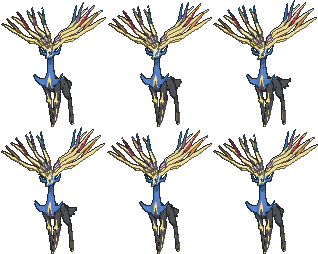
Xerneas
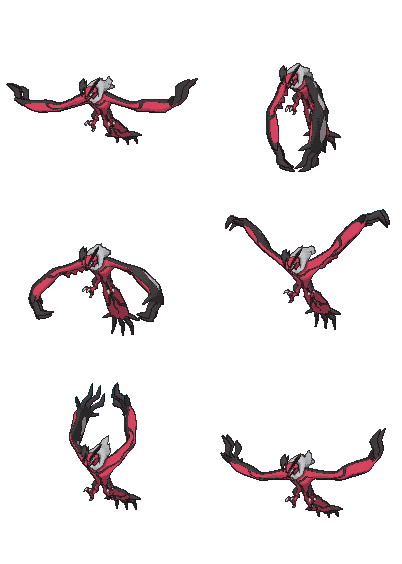
Yveltal

Zygarde
Tapu Koko
Tapu Lele
Tapu Bulu
Tapu Fini

Cosmog

Cosmoem
Solgaleo
Lunala
Necrozma
Zacian
Zamazenta
Eternatus
Kubfu
Urshifu
Regieleki
Regidrago
Glastrier
Spectrier
Calyrex

Enamorus
Wo-Chien
Chien-Pao
Ting-Lu
Chi-Yu
Koraidon
Miraidon

Walking Wake

Iron Leaves
Okidogi
Munkidori
Fezandipiti
Ogerpon
Terapagos
Explore More Pokémon Categories
Continue exploring Pokémon groups, forms, transformations, and special collections across the National Pokédex.


Mythical Pokémon
Discover rare Pokémon traditionally connected to events, special distributions, and unique quests.
Explore


Paradox Pokémon
Compare the ancient and futuristic Pokémon discovered in Area Zero.
Explore


Ultra Beasts
Meet the extradimensional Pokémon that arrived through Ultra Wormholes in Alola.
Explore


Pseudo-Legendary Pokémon
Compare the powerful three-stage families commonly known as pseudo-legendaries.
Explore


Baby Pokémon
Explore all 19 Baby Pokémon, their evolution methods, breeding history, and complete evolution families.
Explore


Fossil Pokémon
Explore every Fossil Pokémon, fossil revival family, evolution, and Galar fossil combination.
Explore