
Starter Pokémon by Generation
Each generation follows the Grass / Fire / Water pattern (with rare dual typings on final forms). Final typings and a practical, one-line read on who benefits most.
Strong early curve against Rock- and Water-themed early gyms in many Kanto layouts; bulk helps newcomers forgive positioning mistakes.
High damage and Fly access for older titles, but Rock gym can feel punishing if you are underleveled—better for players who like aggressive offense.
The most forgiving neutral matchup spread early; simple STAB Surf-style coverage without juggling many typings.


Sturdy and supportive, but fewer super-effective hits against Johto’s early roster—best if you enjoy setup and healing over raw pace.
Fast, hard-hitting Fire STAB for players who want to end fights quickly; still needs backup for Water/Rock roadblocks.
Physical Water with strong Attack—excellent if you like clicking one strong STAB move and moving on.
High Speed and offense for players comfortable switching when typings are bad; less of a tank than rival starters.
Fighting coverage fixes many neutral matchups; historically one of the strongest starter lines when abilities and items are considered.
Only a quad Grass weakness on the defensive chart while gaining Ground STAB—widely considered the easiest Hoenn story pick.
Slow but physically imposing—great if you like tanking hits and firing recoil or high-power Ground moves.
Fast mixed attacker; rewards players who press advantages with varied move types instead of one-button spam.
Many resistances but Ground and Fighting weaknesses hurt—strong pick if you like special-oriented Water/Steel coverage.
Contrary + Leaf Storm is a known competitive package; in story it is workable but less explosive early than peers.
High Attack but low Speed and many weaknesses—fine for casual runs, rough if you dislike taking hits before you move.
Straightforward mixed Water line—comfortable middle ground between Serperior’s finesse and Emboar’s blunt force.
Bulky Grass/Fighting frontliner—good if you want spikes, leech, or physical presence instead of speed.
Special attacker with Psychic coverage—players who like ranged burst and switching out of bad physical matchups.
Speed-first glass cannon profile; excellent if you accept risk in exchange for deleting threats before they act.
Ghost typing adds interesting coverage and immunities; slightly trickier defensively than pure Grass.
Slow physical bruiser—fantastic in doubles thanks to Intimidate, still solid in singles if you pivot around Ground fights.
Special bulk and Fairy STAB help against Dragons and Fighting-heavy routes—great for safer, methodical play.
Grassy Surge support in competitive play; in story it is a strong physical Grass cleaner with good mid-game spikes.
Fast physical attacker—ideal if you want to outspeed gym threats rather than outbulk them.
Sniper-style special Water with high Speed; frail, so pair with items or pivots if fights drag on.
Fast physical sweeper with Protean-style identity in competitive talk—story-wise it deletes slower targets if you keep tempo.
Bulkier special Fire with Ghost coverage—comfortable for players who dislike being one-shot on neutral hits.
Dancer synergy and strong physical Water/Fighting STAB—great if you like setting up or snowballing long fights.
Best Starter Pokémon
“Best” depends on format, but these five lines repeatedly earn respect for story reliability, movepools, typings, or competitive history.
 Swampert— Water/Ground gives Electric immunity and strong STAB pairings; only Grass is truly scary, and even that is manageable with teammates or items.
 Greninja— Extreme Speed with Water/Dark coverage pressures many teams; low bulk means you must pick targets, not tank everything.
 Blaziken— Fire/Fighting coverage is timeless; when Speed Boost is available it scales into one of the most threatening late-game starters in competitive history.
 Infernape— A lighter, faster mixed Fire/Fighting toolkit than Emboar—easier to pilot when gyms resist one damage category.
 Cinderace— Pure Fire with elite physical Speed and movepool tricks in modern rulesets; glassy, but it wins races against many gym staples.
Easiest Starter Pokémon for Beginners
Beginners benefit from forgiving typings, simple STAB plans, or fewer early-game traps—not always the same as “strongest in ranked.”
 Venusaurline — bulk + Grass/Poison STAB removes a lot of early-route guesswork in Kanto-style curves.
- Swampertline — one extra weakness while gaining Ground moves makes route planning very forgiving.
 Blastoiseline — pure Water is easy to understand: spam Water, add Ice or Dark TMs later, done.
 Torterraline — slow but tough; new players who forget type charts still survive mistakes.
 Primarinaline — Water/Fairy offers strong matchup tools against common Fighting and Dragon-themed threats late game.
Starter Pokémon by Type
Starters begin as single types, but finals often pick up a second type. Below, finals are grouped by their primary attacking identity.
Fire (and Fire-led dual typings)
Water (and Water-led dual typings)
Full National Dex listing
Every starter-stage species in one grid—tap a card for stats, moves, abilities, and evolution details.

Bulbasaur

Ivysaur
Venusaur

Charmander

Charmeleon

Charizard

Squirtle

Wartortle
Blastoise

Chikorita

Bayleef

Meganium

Cyndaquil

Quilava

Typhlosion

Totodile

Croconaw

Feraligatr

Treecko

Grovyle
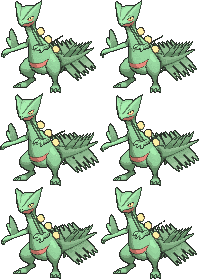
Sceptile

Torchic

Combusken
Blaziken

Mudkip

Marshtomp
Swampert

Turtwig

Grotle
Torterra

Chimchar

Monferno
Infernape

Piplup

Prinplup

Empoleon

Snivy

Servine

Serperior

Tepig

Pignite

Emboar

Oshawott

Dewott

Samurott

Chespin

Quilladin
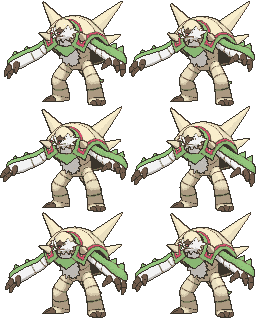
Chesnaught

Fennekin

Braixen

Delphox

Froakie

Frogadier
Greninja

Rowlet

Dartrix

Decidueye

Litten

Torracat
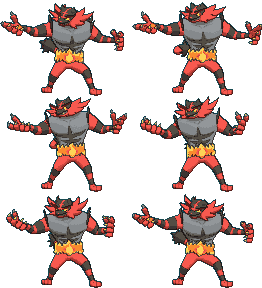
Incineroar

Popplio

Brionne
Primarina

Grookey

Thwackey

Rillaboom

Scorbunny

Raboot
Cinderace

Sobble

Drizzile

Inteleon

Sprigatito

Floragato

Meowscarada

Fuecoco

Crocalor

Skeledirge

Quaxly

Quaxwell
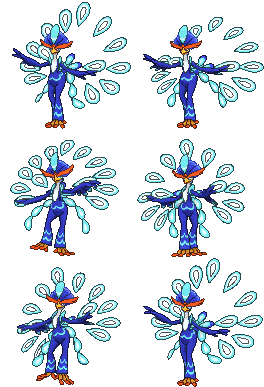
Quaquaval
Explore More Pokémon Categories
Continue exploring Pokémon groups, forms, transformations, and special collections across the National Pokédex.


Legendary Pokémon
Explore region-defining guardians, box mascots, legendary trios, and other rare Pokémon.
Explore


Pseudo-Legendary Pokémon
Compare the powerful three-stage families commonly known as pseudo-legendaries.
Explore


Baby Pokémon
Explore all 19 Baby Pokémon, their evolution methods, breeding history, and complete evolution families.
Explore


Fossil Pokémon
Explore every Fossil Pokémon, fossil revival family, evolution, and Galar fossil combination.
Explore


Eeveelutions
Compare Eevee’s evolutions, evolution methods, types, Abilities, and roles.
Explore


Charizard Forms
Follow the Charmander evolution line and compare Charizard’s major alternate forms.
Explore